









St John’s University Memorial Arch: Modern Architecture
The Way of Learning on an archway: the cultural meaning of the St John’s University Memorial Arch
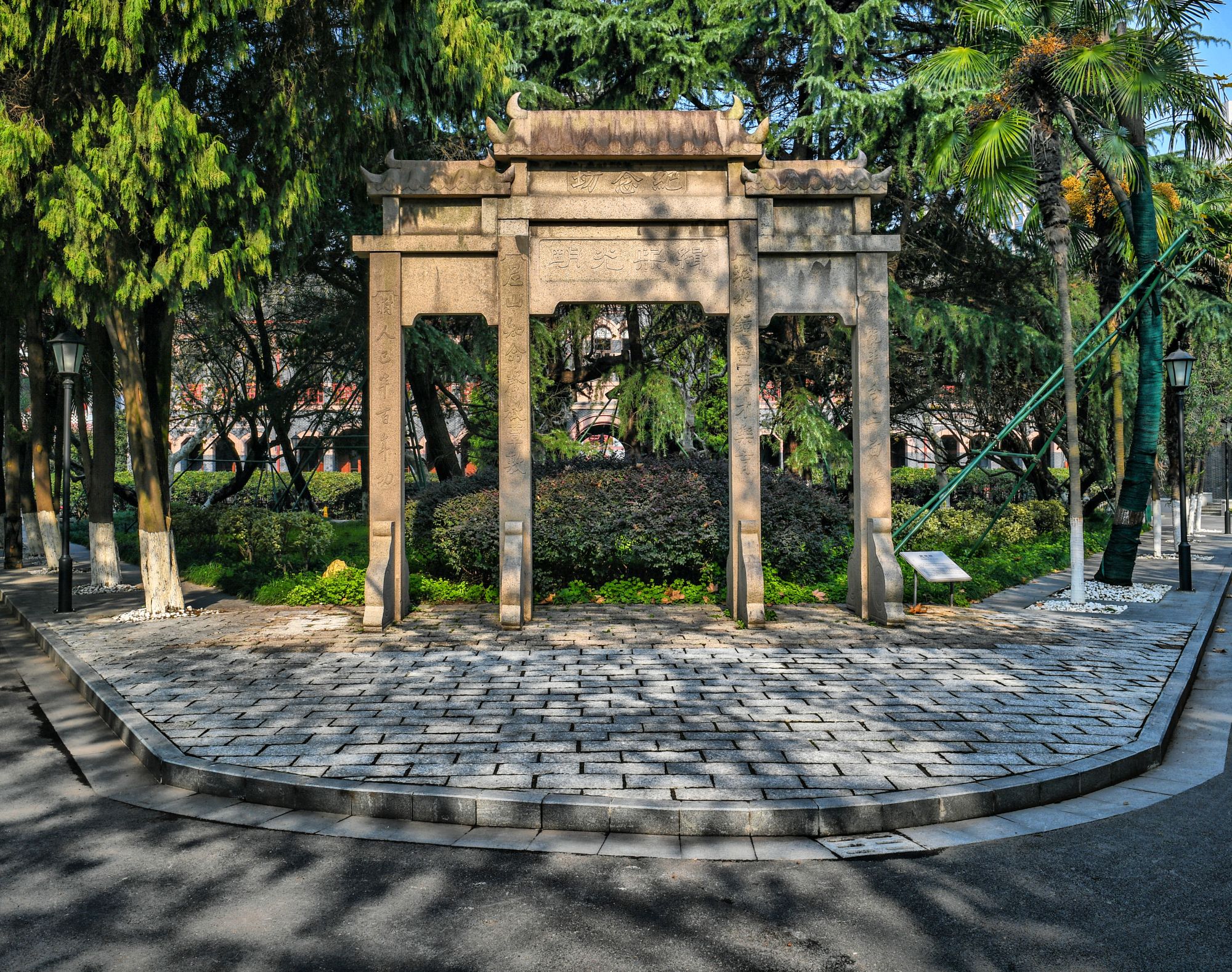
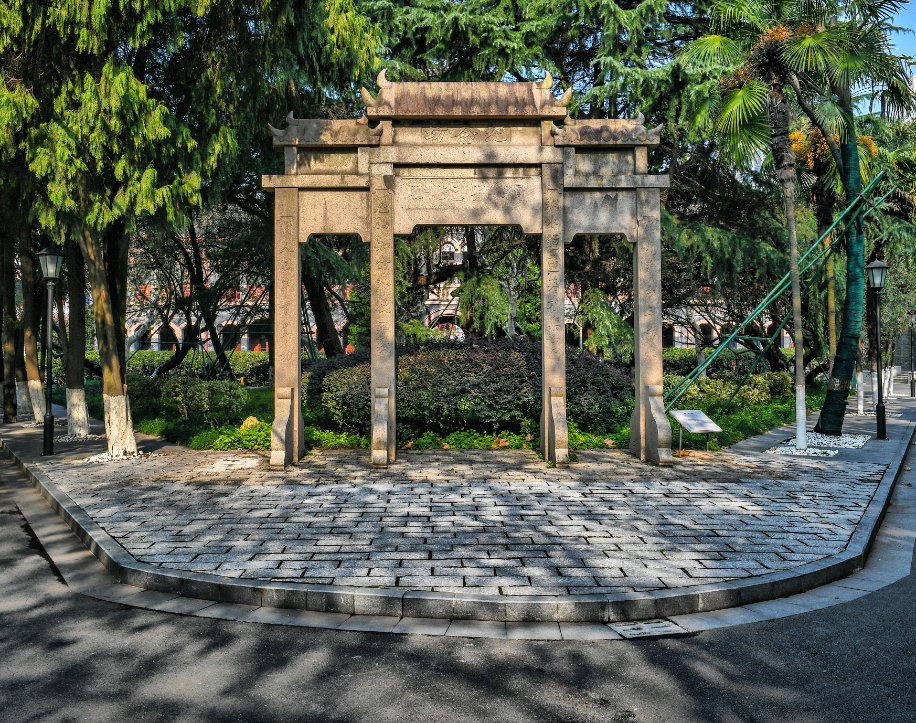
Walking through the Changning Campus of East China University of Political Science and Law and looking back at the history of St John’s University, the Memorial Arch is impossible to overlook. Built in 1929 with funds raised by local gentry and residents of Caojiadu to celebrate the 50th anniversary of St John’s University, the arch combines Chinese and Western couplet culture with the university’s visual identity. It is a distinctive witness to the interaction between Shanghai’s urban merchants, residents, and an academic institution in the modern era.
The Memorial Arch is made of stone and follows a traditional Chinese style. It has four stone pillars, with square columns supporting horizontal lintels and a Chinese-style roof. Two pairs of couplets are carved on both the front and back of the four pillars, together with horizontal inscriptions. The outer couplet on the front reads: “Its setting is evenly divided by water on three sides; its work of nurturing people has already reached half a century.” “Its setting is evenly divided by water on three sides” is an accurate description of the geographical features of the St John’s campus: it stood on a peninsula enclosed by a U-shaped bend of Suzhou Creek, with water on three sides. “Its work of nurturing people has already reached half a century” adapts the allusion from Guanzi · Quanxiu: “It takes ten years to grow trees, but a hundred years to nurture people”, placing 50 years of education within the timescale of learning as something accumulated across generations.
The central couplet says: “By the Song waters, spiritual grace gathers and talented minds are joyfully educated; from Mount Ni, the understanding of destiny spreads its teaching far and wide.” Among the six pairs of couplets, this one is the most intellectually dense. It further places geography, the Wusong River, alongside the sacred teaching of Mount Ni, the birthplace of Confucius and a symbol of the Confucian tradition, showing that St John’s educational practice continued the idea of “Chinese learning as the foundation, Western learning for practical use”.
“Song waters” refers to the Wusong River, or Suzhou Creek, once again anchoring the site through the imagery of water. “Spiritual grace gathers” comes from the phrase “where spiritual grace gathers, outstanding people are nurtured”, meaning that a place where vital energy converges will produce exceptional people. “Talented minds are joyfully educated” is drawn from Mencius · Jin Xin I: “To obtain the talented people of the world and educate them is the third joy”, directly linking St John’s educational mission with the “three joys” of the gentleman described by Mencius. Education is not only a social responsibility, but also a source of spiritual fulfilment. In the lower line, “the understanding of destiny” comes from The Analects · Wei Zheng: “At fifty, I understood the Mandate of Heaven.” It carries a double meaning: first, it refers to the 50th anniversary of St John’s University, the “year of knowing destiny”; second, it points to the natural mission of a school to teach and nurture people. “Its teaching spreads far and wide” comes from The Book of Documents · Yu Gong: “Eastward it reaches the sea, westward it extends to the drifting sands; north and south, its civilising influence reaches to the four seas.” Originally referring to the ruler’s moral education spreading in all directions, its use here for a university suggests that St John’s inherited the Confucian tradition of “educating and transforming the world”.
There are two horizontal inscriptions: the upper one reads “Memorial Arch”, and the lower one reads “Continual Cultivation towards Brightness”. The phrase “Continual Cultivation towards Brightness” comes from “learning advances through continual cultivation towards brightness” in Zhou Song · Jing Zhi. It refers to learning or moral conduct gradually reaching a state of brightness through daily accumulation.
The outer couplet on the back of the Memorial Arch reads: “Understanding propriety and attaining practical use, it nurtures outstanding talents for the nation; renewing the old state with a new mandate, it opens wide the halls of learning and deepens this course through maritime exchange.” The central couplet reads: “Uniting China and the West in one furnace, fifty years of creation and management have made it a flourishing university; in the south-east it stands as a leader, where thousands and tens of thousands are polished and tempered to raise the nation’s glory.” There are also two horizontal inscriptions: the upper one reads “St John’s University”, and the lower one reads “Light and Truth”, the Chinese version of the university motto. On the two sides are the lines: “Learning without thought is labour lost; thought without learning is perilous.”
“Understanding propriety and attaining practical use” may be seen as a variation on the Confucian idea of “illuminating the substance and attaining practical application”. “Understanding propriety” points to inner moral cultivation, while “attaining practical use” points to the ability to put learning into social practice. In the central couplet, “to raise the nation’s glory” is the final emphasis of the whole pair: all these efforts ultimately aim to “enhance the glory of the nation”.
The six pairs of couplets on the Memorial Arch carve the spiritual programme of St John’s University into stone. Today, when we stand before the arch and read them closely, what we sense is the most precious gift of heritage architecture: it allows history to be more than a simple narrative, becoming instead a cultural meaning passed down to the present day.