










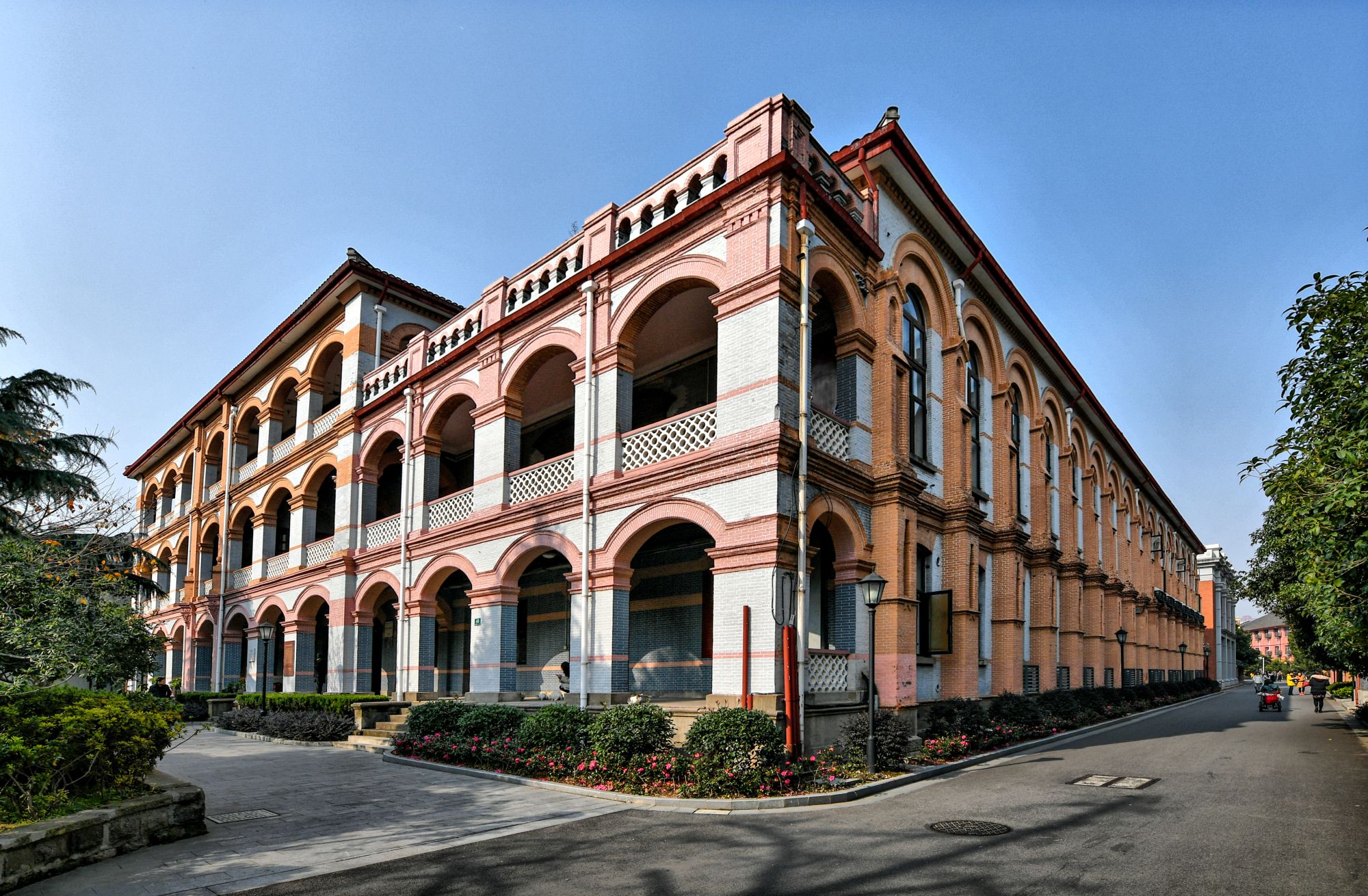
Siyan Hall
A look back at Siyan Hall’s century-long history
On the Changning Campus of East China University of Political Science and Law, within the modern architectural complex of St. John’s University, Siyan Hall (now Building 40) is of particular historical value. Since its completion, the building has left an important mark on both architectural and educational history. As one of the earliest surviving school buildings of St. John’s University, it not only reflects the typical style of modern Chinese university architecture, but also serves as a physical witness to modern Chinese history as the site of Sun Yat-sen’s 1913 speech.
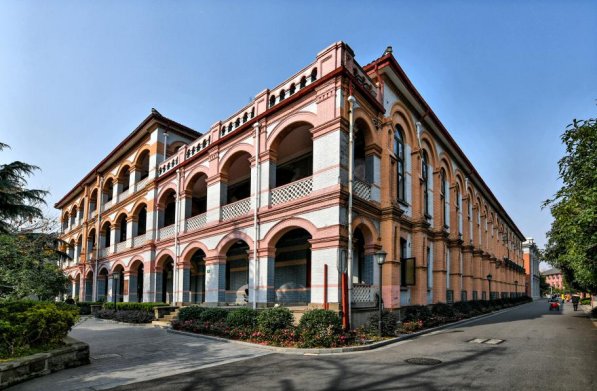
Current photo of Siyan Hall
Siyan Hall was built in 1903. Its cornerstone was laid on 24 December 1903, and the completion ceremony was held on 1 October 1904. The building is a three-storey brick-and-timber structure that combines Chinese and Western styles. Its façade is made of exposed blue-grey brick, with red-brick arches along the exterior corridor, and the roof is a Chinese-style pitched roof.
The name “Siyan” was chosen to commemorate Mr. Yan Yongjing, who contributed to St. John’s University. Yan Yongjing was a noted educator in modern China and one of the founders of Wuchang Wenhua College (the predecessor of today’s Central China Normal University) and St. John’s University.

Historical photo of Yan Yongjing (source: People’s Daily Overseas Edition)
The moment that truly brought this building into the historical record came on 1 February 1913. On that day, St. John’s University held its end-of-term ceremony in Siyan Hall. Mr. Sun Yat-sen, the first Provisional President of the Republic of China, was invited to attend and delivered a speech in the assembly hall.
From the completion of Siyan Hall in 1904, to Sun Yat-sen’s speech in 1913, and then to its designation in 2019 as a Major Historical and Cultural Site Protected at the National Level, Siyan Hall’s century-long journey condenses the full trajectory from modern higher education in Shanghai to legal education in the People’s Republic of China. This building can be said to have long since become a readable, many-voiced historical text.