










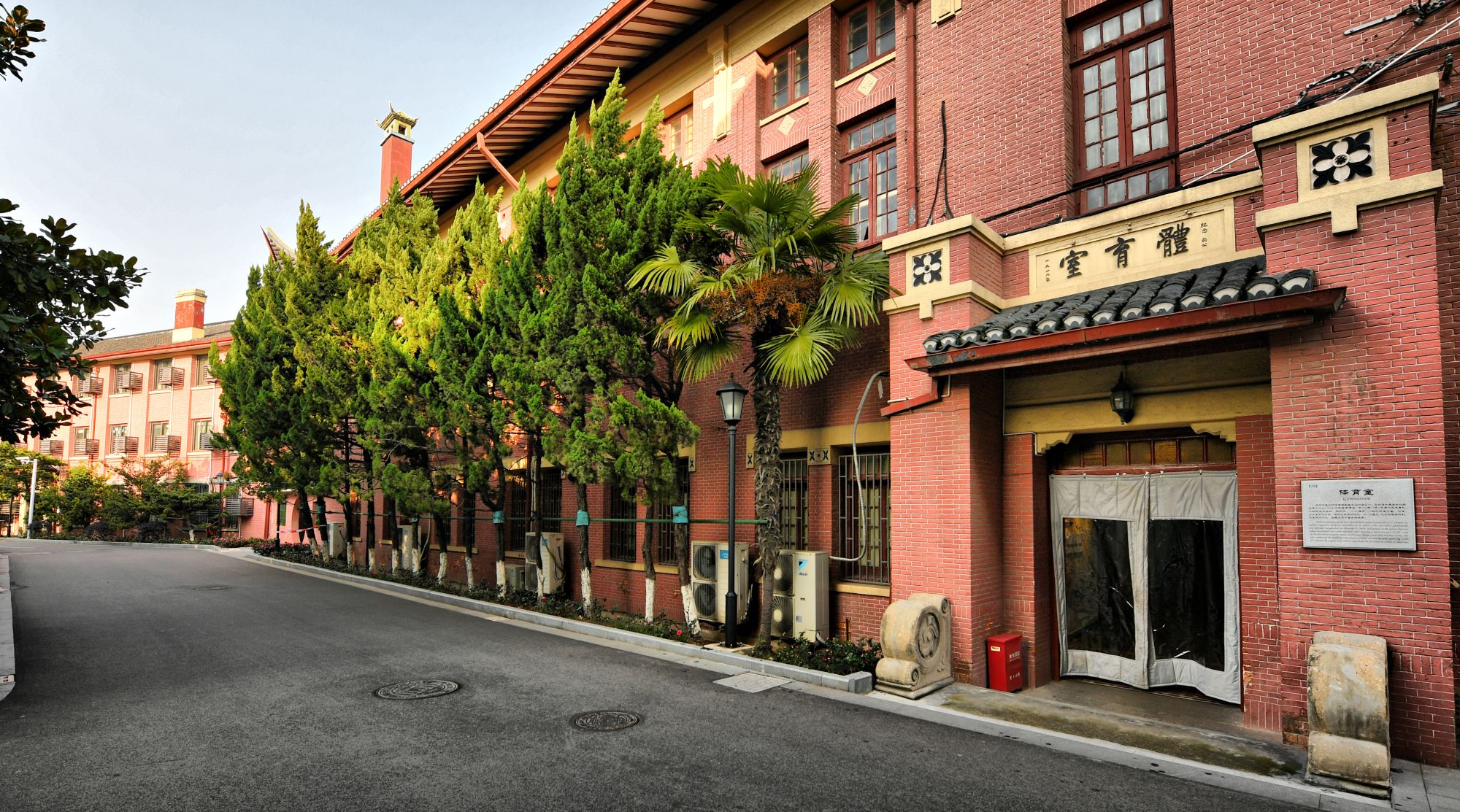
St. John’s University Modern-Era Buildings: F. L. Hawks Pott Memorial Gymnasium
A century of physical education within red-brick walls
The Fellowship Building was first built in 1919 and, after ten years of work, was completed on 14 December 1929, as St. John’s marked the 50th anniversary of its founding. The large fellowship hall on the upper floor was used for meetings and cultural activities, and could also host basketball games. Around the upper part of the hall were spectator stands and a projection room. The lower floor had 11 rooms of different sizes for student societies.
On 15 November 1952, the first opening ceremony of East China College of Political Science and Law was held in the large fellowship hall of the Fellowship Building. Since then, the building has long served as the school’s conference centre and a venue for academic exchange. In 2019, the modern-era architectural complex of St. John’s University was listed in the eighth batch of Major Historical and Cultural Sites Protected at the National Level, with the Fellowship Building included among them. Today, academic discussion and the exchange of ideas continue here, while the building’s layers of history keep growing richer.
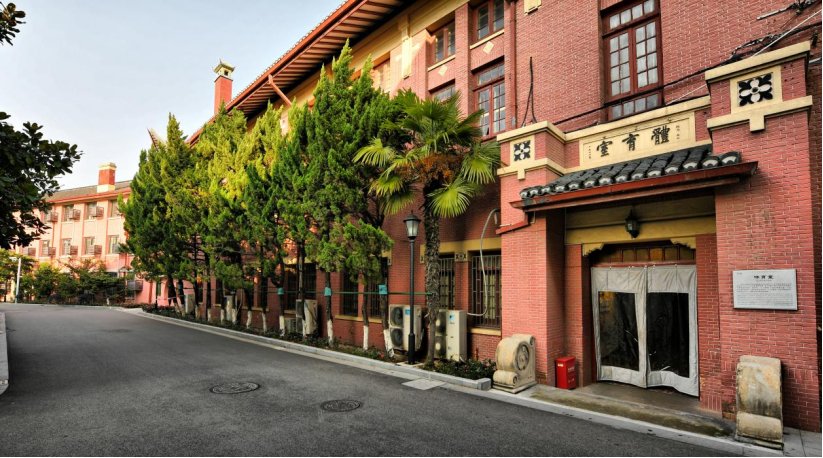
The gymnasium is a two-storey mixed-structure building. Its four roof corners are curved, with chimneys standing on each side. Beneath the large Chinese-style roof with upturned eaves are plain red-brick façades and red wooden window lattices, continuing the early architectural style of St. John’s. It was not only China’s first modern university gymnasium, but also had Shanghai’s first school swimming pool: on the east side of the ground floor, the heated pool was covered with a glass canopy, measured 60 feet long and 20 feet wide, and was lined on the bottom and all four sides with white ceramic tiles, which was especially rare at the time. To reduce the impact of water vapour on the historic building, East China University of Political Science and Law has now laid a wooden floor and converted it into a gymnastics room, though it can be restored to its original appearance at any time.
The completion of the gymnasium coincided with a key period when physical education at St. John’s was shifting from “encouraging sport” to “popularising sport”. From 1921, St. John’s introduced a two-year compulsory exercise system for students: during daily extracurricular exercise time, the school closed all dormitories, classrooms and the library, requiring students to leave the classroom and take part in physical training. The gymnasium provided ample indoor space for this system to be carried out, so that even in bad weather students could still be active on covered courts and in the swimming pool.
Ma Yuehan, a renowned physical education scholar in the history of modern Chinese sport, was a representative figure of St. John’s golden age of athletics. Enrolled in 1904, he was a member of St. John’s varsity teams for seven consecutive years and helped St. John’s win the championship banner at intercollegiate sports meets seven times in a row. In 1905, he won the one-mile race at the “International Games” in Shanghai, and in 1910 he came first in the 880-yard race at the “National Games” in Nanjing. He later served as vice-chairman and chairman of the All-China Sports Federation, and as a deputy to the First, Second and Third National People’s Congresses. He devised nearly one hundred sets of calisthenics, published works including The Transfer Value of Physical Education, and advocated the slogan “Work healthily for the motherland for fifty years”. Honoured as the “father of physical education in China”, his ideas and practice in sport were deeply rooted in his experiences at St. John’s.